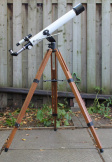
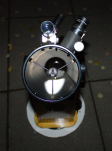
Caroline Herschel discovers her first comet, Comet C/1786 P1 (Herschel).
2
825 years ago, in 1133:
King Henry's Eclipse occurs over England, with totality lasting for over four minutes, and coinciding with the death of King Henry I.
3
2389 years ago, in -431:
The oldest European record of a verifiable solar eclipse (annular) is given by the Greek historian Thucydides.
362 years ago, in 1596:
David Fabricius discovers the first known periodic variable star, Mira, in the constellation of Cetus.
4
5
6
7
8
9
10
185 years ago, in 1773:
Charles Messier first observes NGC 205, also known in later years as M110.
11
12
81 years ago, in 1877:
Asaph Hall, Sr., an American astronomer, discovers the first of Mars' moons, Deimos.
13
60 years ago, in 1898:
433 Eros, the first discovered and second-largest near-Earth asteroid, is discovered by the German astronomer Carl Gustav Witt at the Berlin Urania Observatory.
28 years ago, in 1930:
A meteor explodes in an air burst over the Curuca River area in Brazil.
14
161 years ago, in 1797:
Caroline Herschel and Eugene Bouvard independently discover Comet C/1797 P1 (Bouvard-Herschel).
15
16
17
25 years ago, in 1933:
Under the leadership of Sergey Korolev, the Group for the Study of Reactive Motion (GIRD) launches the first Soviet liquid-fueled rocket.
This year:
Able 1 (Pioneer 0) is the world's first craft intended for launch out of Earth's orbit, but explodes 77 seconds after lift-off.
18
90 years ago, in 1868:
French astronomer Pierre Jules César Janssen discovers an unknown element, now known as helium, in the spectrum of the sun during a total eclipse.
81 years ago, in 1877:
Asaph Hall, Sr., an American astronomer, discovers the second of Mars' moons, Phobos.
19
This year:
Thomas Keith Glennan becomes the first Administrator of NASA.
20
73 years ago, in 1885:
Ernst Hartwig, at the Dorpat Observatory in Estonia, discovers supernova SN 1885A in Andromeda, the first Type Ia detected outside our galaxy.
21
1 year ago, in 1957:
A Soviet R-7 Semyorka is launched and flies 6000 km (3700 mi) to become the world's first ICBM.
22
23
24
This year:
Explorer 5 is launched, but fails when the rocket's first stage collides with its second stage after separation.
25
93 years ago, in 1865:
The Shergotty meteorite, the first example of the shergottite Mars meteorite family, falls to Earth in Shergotty (now Sherghati) in the Gaya district, India.
26
27
185 years ago, in 1773:
Caroline Herschel independently discovers NGC 205, also known in later years as M110.
28
169 years ago, in 1789:
William Herschel discovers a moon of Saturn, Enceladus.
29
30
31
26 years ago, in 1932:
G. G. Cillié of the United Kingdom and Donald H. Menzel of the United States use eclipse spectra to show that the Sun's corona has a higher temperature than the photosphere.
8 years ago, in 1950:
The first mouse is sent into space aboard a U.S. launched V-2, but dies when the rocket disintegrates due to parachute failure.




 It's been 3966 days